Design and Footprint
The source review details a ride through San Carlos, California, highlighting America’s smallest electric truck and its striking departure from traditional vehicle geometry.
Tiny pickup trucks might just become a viable option in the US if the California-based startup Telo successfully brings its design to mass production.
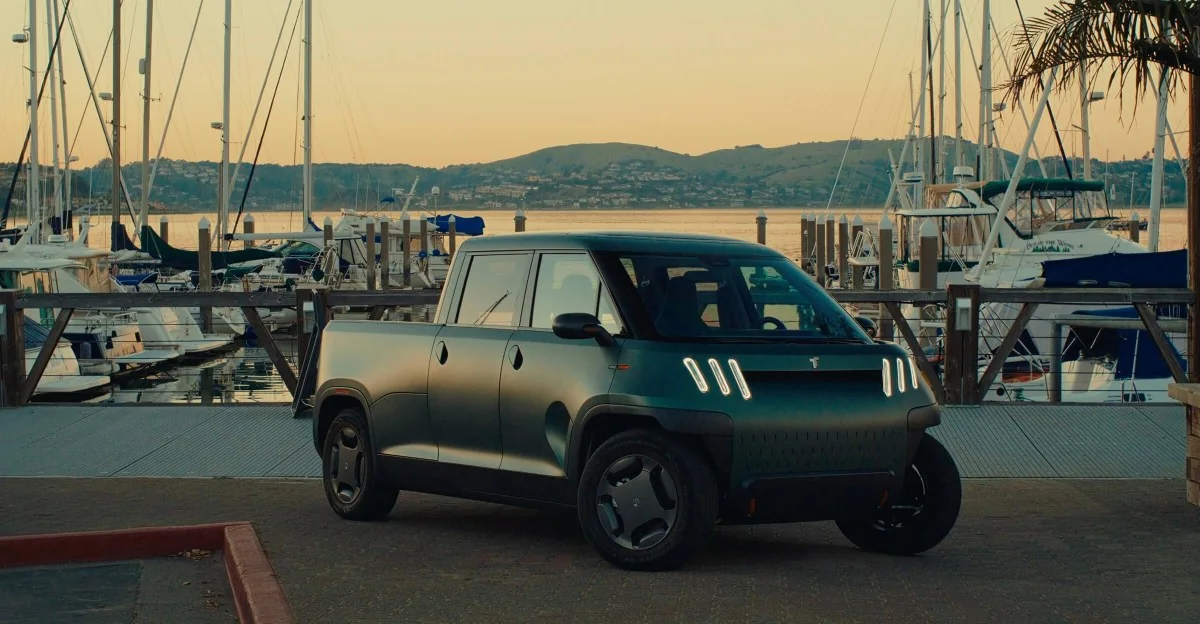
The Telo MT1 mini truck turns heads due to a distinct layout that breaks away from conventional automotive design norms.
It features a nearly cab-over configuration where passengers sit close to the front axle, resembling a Japanese kei truck layout while offering four doors.
The interior offers unexpected spaciousness with firm seats. The ride is stable yet firm, benefiting from a low center of gravity supplied by the under-floor battery pack.
Behind the wheel, the vehicle handles like a nimble, light pickup truck with a stiff ride when unladen, complemented by typical electric vehicle low-end torque and immediate acceleration.
Production variants are engineered to achieve 0–60mph acceleration in roughly four seconds, matching the responsiveness of standard electric vehicles.
Despite its compact dimensions roughly matching a two-door Mini Cooper, the MT1 provides an 8,000-pound tow rating and a full 96-inch bed.
Company leadership emphasizes that smaller trucks offer significantly safer urban footprints compared to massive modern consumer pickups.
Battery, range, and layout
The MT1 offers a 77kWh battery pack or an extended 106kWh pack delivering up to 350 miles of estimated range. The vehicle utilizes a dual 800V and 400V architecture, enabling compatibility with Tesla V3 Superchargers alongside high-powered regional stations.
Battery packs are assembled in-house with individually fused cells to isolate potential faults. The thermal management system combines passive cooling during parking with active liquid cooling while driving.
Measuring 152 inches in total length, the prototype features a midgate that folds flat to expand storage into a full-sized 96-inch bed.
To compensate for the lack of a traditional front trunk, engineers integrated a door-to-door storage tunnel beneath the truck bed capable of accommodating roll-aboard luggage.
The cabin is expected to house dual 13-inch digital displays supporting Android Auto and Apple CarPlay alongside steering-wheel scroll controls.
How the Telo stacks up against the big trucks
While imported Japanese kei trucks fail US crash safety regulations, Telo developed a proprietary front-end structure and hinge pillar to clear regulatory hurdles.
The re-engineered hinge pillar handles structural duties, strut mounting, and dash integration simultaneously, reducing overall front-end component counts by half.
The engineering team overhauled conventional crash architecture from scratch with dedicated safety specialists.
The frame incorporates multiple crash energy distribution paths and specialized torque boxes to protect the occupant compartment.
AI tools facilitated rapid virtual crash simulations running continuously, with the body-in-white structural skeleton manufactured by Schwab Industries in Michigan.
Physical crash validation testing is scheduled ahead of upcoming customer delivery targets.
Company leadership notes that modern software and AI tools significantly streamline hardware development timelines.
Pricing, delivery, and other features
The MT1 will be offered in single-motor rear-wheel-drive and dual-motor all-wheel-drive configurations, with add-ons including solar tonneau covers and camping shells. Base pricing starts at $41,520 with reservations open for $152.
In-house battery pack production and domestic body assembly position the company favorably regarding regional supply chain tariffs.
Reservation volumes have exceeded 14,000 units, with a large majority configuring long-range AWD packages and roughly 20 percent coming from first-time vehicle buyers.
Profitability targets sit around 5,000 vehicles within two years of launch, with initial customer deliveries planned for 2027 pending regulatory certification.
The manufacturer aims to maximize electric vehicle architecture potential through efficient space utilization and a purposeful 'one-box' design.
Core development focuses entirely on user experience and the functional advantages enabled by electric powertrains.
Despite historical market hurdles for electric vehicle startups, the Telo MT1 presents a compelling alternative for urban drivers seeking manageable vehicle dimensions.