MSI PRO MAX Edge AI+: 30-second review
The MSI Pro Max Edge AI+ is one of the most powerful mini workstations evaluated by the source review, proving to be a capable tool for creative applications and running AI offline. Inside sits AMD’s Ryzen AI Max+ 395, backed by Radeon 8060S graphics and 128GB of unified memory to support local language models.
This hardware combination enables the system to run surprisingly large local AI models managed within Lemonade. Tasks included sorting more than 2,600 images, generating imagery using Flux and Qwen3 Coder models through Visual Studio Code, and building a multi-page website.
Performance for standard creative work using Photoshop, Lightroom, and Premiere Pro was equally robust, handling batches of Sony RAW files and editing 4K Canon footage smoothly.
Drawbacks include a high price tag, a 2.5Gb Ethernet port that feels restrictive for a machine of this tier, and the inherent setup complexity required to get the most out of local AI applications.
Once configured, however, the Pro Max Edge AI+ delivers an enormous amount of processing power packed into a relatively compact footprint for private, offline workloads.
MSI PRO MAX Edge AI+: Price and availability
The MSI Pro Max Edge AI+ is available directly from MSI and online retailers starting from $5,499 in the US, €5,299, and £5,999.
MSI PRO MAX Edge AI+: Design
The mini PC arrives with a slightly larger form factor than typical compact boxes, accommodating a Strix Halo CPU alongside an integrated GPU and NPU.
The machine features 128GB of unified RAM soldered to the motherboard and AMD Radeon 8060S integrated graphics, optimized to handle large language models.
Measuring 197.5 x 188.4 x 94.5mm and weighing 2.9kg, it remains portable. The power supply is integrated directly into the chassis, avoiding an external power brick.
It sits comfortably on a desktop while offering enough portability for professionals who need to travel with their hardware.
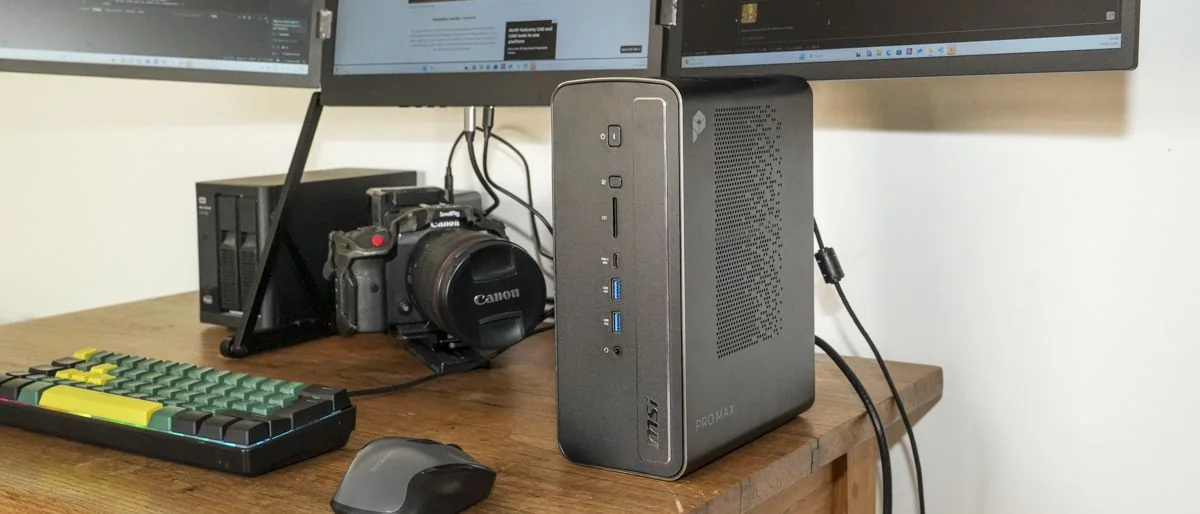
The chassis provides ample space for a wide array of ports, positioning the unit somewhere between a traditional mini PC and a mini tower.
Front connectivity includes two 10Gbps USB Type-A ports and a 40Gbps USB4 port supporting DisplayPort 2.0 and 15W power output.
A full-sized SD 4.0 UHS-II card reader and a 3.5mm audio jack are also located on the front panel, alongside a performance mode switch to toggle between Performance and Eco modes.
The rear panel houses two USB 2.0 Type-A ports, a USB 3.2 10Gbps Type-A port, a 40Gbps USB Type-C port with DisplayPort 2.0, HDMI 2.1, DisplayPort 1.4, a 2.5GbE RJ45 Ethernet port, and an audio combo jack.
Internally, two M.2 NVMe slots are available, with one populated by a 2TB PCIe Gen 4 x4 SSD. The onboard RAM cannot be upgraded.
The lack of an OCuLink port for an eGPU is a minor missed opportunity, and the 2.5GbE networking limit feels conservative given the price point, but build quality remains exceptional.
The Strix Halo Ryzen AI Max+ 395 CPU is paired with an integrated Radeon 8060S GPU, an NPU, and 128GB of LPDDR5X-8000 unified RAM to facilitate fast AI task execution.
The 16-core, 32-thread Zen 5 processor balances overall computing capabilities effectively, though it represents a significant financial investment.
Combined with the integrated AMD XDNA NPU offering up to 50 TOPS, the system yields a potential 126 TOPS of processing power across its processors.
Dual M.2 NVMe slots provide straightforward storage expansion, while dual USB4 ports allow fast external storage attachments.
Windows 11 Pro comes pre-installed alongside MSI's management software for controlling system performance profiles and security settings.
An integrated 300W power supply supplies the necessary wattage to sustain these heavy AI-enhanced workloads.
Wireless connectivity is handled by Wi-Fi 7, while wired networking relies on a single 2.5GbE LAN port.
MSI PRO MAX Edge AI+: Performance
Initial setup follows standard Windows procedures, with the machine ready for software deployment within minutes of connection.
Testing incorporated Microsoft Office productivity apps alongside Adobe Creative Suite programs (Photoshop, Lightroom, Premiere Pro) and DaVinci Resolve.
To evaluate local AI potential, applications like Lemonade were deployed alongside models including Flux, Qwen 3, and Qwen 2.5.
General productivity tasks run smoothly, allowing multiple Microsoft Office applications to operate concurrently without noticeable system slowdowns.
Web browsing across numerous Edge windows demonstrated solid stability, supported by a reliable Wi-Fi 7 connection.
Using Adobe Bridge with thousands of Sony RAW files showcased the capability of the processor and Radeon 8060S GPU in rendering high-resolution thumbnails rapidly.
Thumbnail rendering times were minimal, enabling smooth scrolling through large image libraries without noticeable lag.
Batch adjustments in Adobe Camera Raw and subsequent editing in Photoshop proceeded fluidly, loading files into workspace environments within seconds.
Compared to standard desktop workstations, the rendering speeds observed on this mini PC exceeded expectations for handling large photo batches.
Generative expand and image generation render times averaged a few seconds, while 4K video editing in Premiere Pro using Canon C-Log footage handled cuts effortlessly.
The hardware processed extensive 4K footage edits smoothly, resembling the workflow experience of managing lighter 1080p clips.
While editing from external Thunderbolt drives worked well, the limited 2.5GbE network port restricted high-speed network editing via NAS storage solutions.
The machine's video editing performance naturally led into assessments of its local artificial intelligence capabilities.
Local AI testing involved installing Lemonade to download and execute various large language models tailored for specialized tasks.
Models like Qwen 2.5-VL were used alongside ExifTool to inspect images and organize asset files for subsequent web development projects.
Qwen3-Coder proved effective for generating HTML and CSS Grid layouts within Visual Studio Code after initial configuration.
File organization tests fed over 2,600 images into the system using specialized models to categorize and recognize image contents automatically.
While automated sorting proceeded at a steady pace, underexposed or nondescript images occasionally required secondary vision model analysis.
Configuring local AI models involves a noticeable learning curve and requires dedicated experimentation to match specific user workflows.
Additional testing involved building a static website using Visual Studio Code combined with the Continue extension and local coding models.
The local model successfully structured CSS layouts and generated review text based on project asset folders and design prompts.
Automated file creation within Visual Studio Code required individual prompt approvals for generated files during testing sessions.
Generated HTML code proved clean and structured, though minor JavaScript adjustments were occasionally needed to finalize layouts.
Server logs recorded significant token processing across multiple requests to complete a functional ten-page static website build.
Token generation speeds reached competitive levels, rivaling certain cloud-hosted models while running entirely offline.
Extended experimentation with various models highlighted file organization as one of the most practical applications for the hardware.
Monitoring hardware utilization revealed heavy reliance on the CPU and GPU during vision model tasks, with occasional NPU involvement.
Fully engaging the NPU depends on selecting compatible model architectures, highlighting the experimental nature of current local AI deployment.
General users relying on built-in AI tools within standard applications will see background acceleration managed automatically by the processor and NPU.
Early experiments integrating AI into DaVinci Resolve produced promising rough cuts, indicating strong potential for video editing automation.
The presence of 128GB of onboard memory prevents the system from stalling during intensive multi-layered tasks.
Generative image creation tasks using Flux models produced custom artwork locally within seconds without cloud server intervention.
While offline generative models occasionally display minor artifacting quirks, their ability to operate entirely locally remains impressive.
MSI PRO MAX Edge AI+: Final verdict
The MSI Pro Max Edge AI+ delivers strong performance driven by its Strix Halo processor, integrated Radeon 8060S GPU, and NPU.
Supported by 128GB of unified RAM and fast storage, it offers genuine capability for running local language models, though setup requires patience.
Configuring local models and understanding how different architectures utilize the CPU, GPU, and NPU involves a notable learning curve.
First-time users should anticipate spending time downloading content and testing models to optimize the system for specific requirements.
Once configured, the hardware yields exceptional output, distinguishing itself from lesser machines lacking comparable RAM and AI acceleration.
Combining cloud AI for prompt assistance with local AI for heavy processing represents an efficient workflow strategy for this system.
Despite its high cost, the mini PC provides a capable platform for users seeking dedicated offline artificial intelligence capabilities.